Introduction
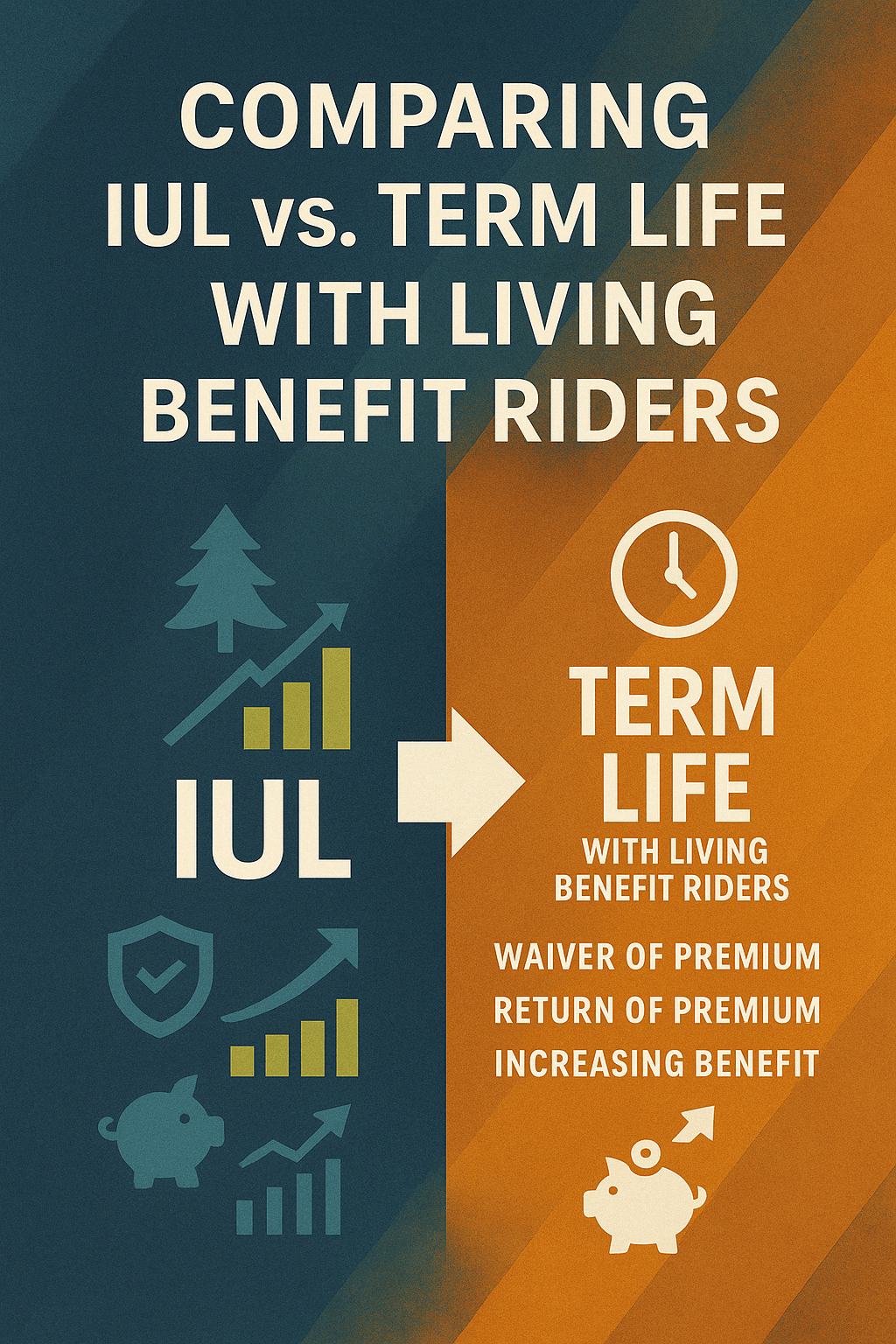
In the world of life insurance, choosing the right policy is crucial in protecting your loved ones and aligning your financial goals. Two popular approaches are Indexed Universal Life (IUL) insurance and Term Life insurance with Living Benefit Riders. This article examines these options while incorporating valuable riders such as waiver of premium, return of premium, and increasing benefit riders. We’ll also discuss how investing the savings from a term policy into a retirement Fixed Indexed Annuity (FIA) can be an effective strategy for long-term wealth accumulation.
1. Understanding the Basics
Indexed Universal Life (IUL) Insurance
IUL is a permanent life insurance policy that offers lifelong coverage. A portion of your premium goes toward building a cash value that increases based on a specific stock market index (such as the S&P 500) while protecting your principal from market downturns. The policy also provides flexibility in premium payments and death benefits. This dual functionality means you gain both a death benefit and an investment component, allowing tax-advantaged growth over time.
Term Life Insurance with Living Benefit Riders
Term life insurance provides coverage for a set period—typically 10, 20, or 30 years—at a lower cost. While it offers no cash value accumulation, it can be enhanced with living benefit riders. These riders enable you to access a portion of the death benefit in the event of a critical, chronic, or terminal illness, thereby providing financial relief while still alive. Living benefits are especially valuable for policyholders facing unexpected health challenges.
2. Enhanced Protection with Living Benefit Riders
Riders can significantly alter the risk and reward profile of your life insurance policy. Here, we discuss three key riders:
a. Waiver of Premium Rider
The waiver of premium rider protects you by suspending premium payments if you become totally disabled. This ensures that your policy remains active regardless of your inability to pay due to a disability. It relieves financial pressure during challenging times and guarantees that your coverage endures.
b. Return of Premium Rider
A return of premium rider offers an attractive proposition: if you outlive the policy term, you receive all or a portion of the premiums paid back at the end of the policy term. Although this rider usually comes at a higher cost, it adds a savings or cash-back component to what is otherwise a temporary safety net.
c. Increasing Benefit Rider
An increasing benefit rider allows the death benefit to grow over time to address the challenges of inflation and increased future financial needs. This rider ensures that the value of the protection you’re purchasing does not diminish in real terms over the long term. However, an increasing benefit rider typically leads to higher premiums as the risk to the insurer grows.
3. The “Buy Term and Invest the Difference” Strategy
For those who are cost-conscious yet seek robust retirement planning, the “Buy Term and Invest the Difference” strategy is worth considering.
Term Life Insurance as a Base
Term life insurance is far less expensive than IUL, allowing you to secure a significant amount of coverage at a lower cost. This affordability factor means that a larger portion of your income can remain available for other investments.
Investing the Difference into a Fixed Indexed Annuity (FIA)
A Fixed Indexed Annuity (FIA) offers a compelling retirement strategy. FIAs are designed to provide tax-deferred growth linked to market indices, with a guarantee against market losses through a guaranteed minimum interest rate or floor. Essentially, after paying for term insurance, the money saved can be directed into an FIA, which not only adds the potential for market-linked growth but can also provide a guaranteed stream of income during retirement. This approach divorces the investment component from the life insurance product, allowing each to perform in its optimal role.
4. Comparing and Contrasting the Two Approaches
IUL Insurance
- Coverage Duration:
- Lifelong protection under one policy.
- Cash Value Component:
- Accumulates cash value with potential tax-free access, but returns are subject to caps and participation rates.
- Premium Flexibility:
- Allows adjustable premiums and death benefits, though optimal performance requires ongoing funding.
- Living Benefits:
- Some IUL policies may offer limited living benefits; however, their core strength lies in the combined investment and insurance product.
- Cost Considerations:
- Higher premiums due to permanent coverage and cash value features.
Term Life Insurance with Living Benefit Riders + FIA Strategy
- Coverage Duration:
- Term coverage offers protection for a specific period, ideal for covering temporary obligations.
- Cost Efficiency:
- Lower premiums free up capital to invest.
- Enhanced Riders:
- Living benefit riders (waiver of premium, return of premium, and increasing benefit riders) enhance coverage during emergencies.
- Investment Opportunity:
- The savings from lower term premiums can be effectively invested into an FIA, which offers market-indexed growth with downside protection and potential retirement income.
- Flexibility:
- Conversion options may be available, allowing you to transition to permanent coverage as your needs evolve.
5. Which Option Fits Your Financial Goals?
The choice between IUL and a Term Life policy (enhanced with riders and coupled with an FIA investment strategy) depends on your priorities:
- Opt for IUL if:
- You desire lifelong protection with a built-in cash value component.
- You are comfortable managing a more complex product with flexible but potentially higher premiums.
- Tax-advantaged cash accumulation that can supplement retirement income is a key goal.
- Opt for Term Life with Living Benefit Riders + FIA if:
- You have a limited budget yet need significant coverage for your family’s immediate financial responsibilities.
- You prefer to minimize your insurance cost while directing the savings to build retirement wealth.
- You value supplemental riders that offer additional financial protection during health crises, along with the flexibility to convert if your circumstances change.
Conclusion
Life insurance is far from a one-size-fits-all product. An IUL provides lifetime coverage with investment benefits built into the policy but comes at a higher premium and greater complexity. In contrast, Term Life Insurance—when enhanced with riders such as waiver of premium, return of premium, and increasing benefit features—offers robust protection at a lower cost. When you invest the premium savings into a Fixed Indexed Annuity (FIA), you not only secure coverage for your family but also build a retirement nest egg that grows with market exposure while safeguarding your principal.
Ultimately, making an informed decision requires aligning your policy with your long-term financial objectives and risk tolerance. Consulting with Jason Murry & his financial strategists and advisors today! It is essential to tailor these strategies to your individual needs through our Expert Financial Analysis.
References:
- Indexed Universal Life (IUL) Insurance:
Investopedia – Pros and Cons of Indexed Universal Life Insurance - Term Life Insurance:
Investopedia – Term Life Insurance - Waiver of Premium Rider:
Investopedia – Waiver of Premium - Return of Premium Rider:
Investopedia – Return-of-Premium Life Insurance - Increasing Benefit Rider:
(While a dedicated Investopedia article may not exist solely for this rider, similar concepts are discussed in various insurance resources; you might start here for an overview on related topics and riders:)
Investopedia – Understanding Term Life Insurance Riders - Fixed Indexed Annuity (FIA):
Investopedia – Fixed Indexed Annuity

 Financial Durability